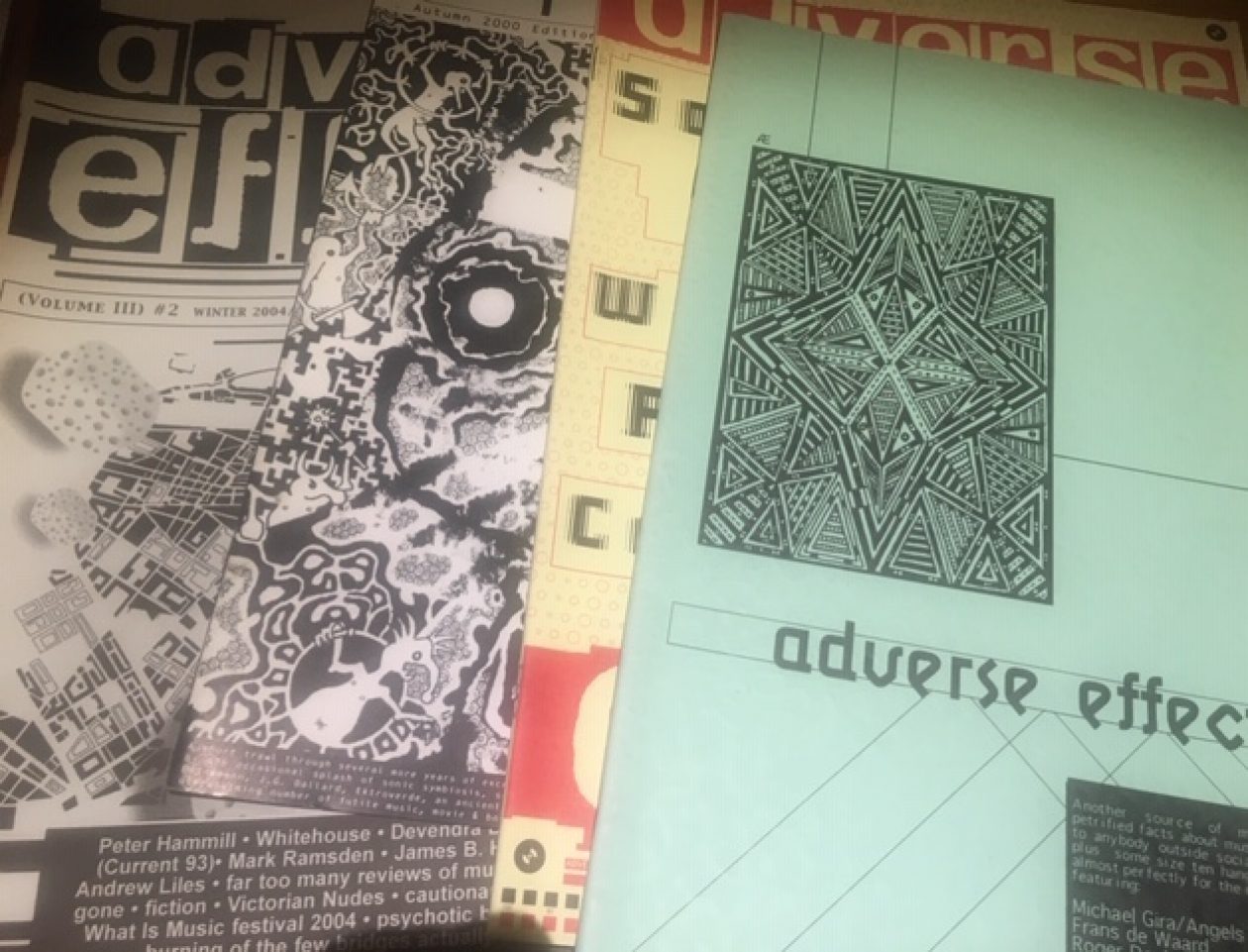
As always, please note that we are ‘old school’ and only review releases sent on physical formats. Downloads and streaming links tend to get lost due to the amount of emails received daily not only due to Adverse Effect, but also because of Fourth Dimension Records and its associated labels, plus the book publishing wing. We fully understand and appreciate the additional costs involved in sending vinyl, CDs and cassettes, etc., but we do at least get to everything sent in due course. We also inform you directly once a review is uploaded.
If interested in a review, please send material to the usual address:
Adverse Effect c/o Richo
Winnicka 57B
32-020 Wieliczka
Poland
Email: richo_j@hotmail.com
To get an idea of where our interests are, check out the other reviews pages on the site.
NB: 2023 reviews are by Richard Johnson and Steve Pescott
____________________________________________________________________________

And Also The Trees The Bone Carver CD (AATT, 2022)
Amazingly, The Bone Carver is And Also The Trees’ fourteenth album in just over forty years. During this time, and since their 1982 debut cassette album From Under the Hill (now to be found accompanying 2020’s remastered reissue of the eponymous 1984 debut LP), itself partly co-produced by The Cure’s Robert Smith and Mike Hedges, the group has danced along a trajectory of its own making that’s unfortunately never seen it gain the wider recognition it deserves. Having initially bubbled up from the vibrant post-punk quagmire of the time, AATT soon shed more direct references to this as they perfected a sound which whilst still sometimes affectionately nodding back to earlier times actually embraced a maturity which went beyond their years. Combining a romantic, poetic and literary stance with songwriting which could confidently sway from sombre ballads to music of a more dramatic or even ravaged nature, there was always a keen cinematic quality attached to this perfect backdrop to vocalist Simon Jones’ figural lyrics and often moody delivery. Only Tindersticks appear like contemporaries, but even then any such (loose) reference falters at various junctures along the way, thus rendering it even harder to understand how AATT never broke far beyond the appeal of a limited but thankfully diehard and fervent audience.
The Bone Carver is no different with respect to the group’s apparently indelible craftsmanship, either. The album’s opener, ‘In a Bed in Yugoslavia’, tends to set the tone for the remainder with majestic guitar work from Simon’s brother and co-founder Justin, a powerful and energetic rhythm section courtesy of Paul Hill (drums) and Grant Gordon (bass), plus a tempered yet melancholic clarinet refrain by Colin Ozanne. The latter makes several more appearances throughout the album and although a largely subtle and unobtrusive presence is all the more effective for it. On the redolent ‘The Book Burners’, we are treated to Justin’s trademark mandolin-inspired guitar sound while the title track once again utilises this for one of the most glorious exercises in jazz-tinged sonic vistas the group offers here. As always, every song both complements the setting of its bedfellows and appears like the result of a mastery that’s lost a lot of blood, sweat and tears along the way.
Everything adds up to an album that might not necessarily mark it out from a number of others in AATT’s vast, rich and beautiful catalogue, but still stands like a giant in a sea of music that can only at best be described as ordinary. A triumph in and of itself. (RJ)

Drew Daniel / John Wiese Continuous Hole CD (Cold Spring, 2023)
Reissue of this collab album that originally appeared in 2018 on US label Gilgongo Records and collects eleven pieces of scrambled digital flotsam moulded into musique concrete shapes that often seem like somebody’s playing with the volume control and a tuner whilst having their fillings removed. At times it gets a little rhythmic, but that’s no surprise given Drew’s being a member of hep avantronica act Matmos. John Wiese, meantime, is another prolific American noisenik with more releases to his name than most could ever keep up with. Perfect lughole irrigation music. (RJ)

Dengue Fever Ting Mong CD (Tuk Tuk Records, USA, 2023)
Ting Mong is the sixth album by this Los Angeles-based group devoted to fusing Cambodian music with an indie setting which sometimes embraces rock, pop and the lighter end of psychedelic music. It’s an eclectic mix that, spread over the nine cuts here, sometimes assumes a slow jam stance or dives deep into a pocket of airy and melodic folk. Along the way, there are subtle hints of oddness sewn into the mix but mostly these songs are focussed and driven by vocalist Ch’hom Nimol’s sweeping bouts of melancholia. Alongside arrangements that wouldn’t sound at all out of place scoring a fantastic film such as Triangle of Sadness, the entire album might take a couple of listens to truly sink in yet is remarkably beguiling because of this. And, if you’re wondering, Ting Mong means mannequin or scarecrow or suchlike. That’s a neat enough introduction to Cambodian in my book. (RJ)

Dim Gray Firmament CD (Plane Groovy, Norway, 2022)
Second album from a Norwegian trio who each resemble IT students, which possibly says more about Firmament than the music itself. If slightly art-strained grandiose indie-rock bursting with pomp is your bag, you might find something to savour here. The biggest hurdle for me, however, is the fact it all veers dangerously close to Coldplay territory at times. One Coldplay is already one far too many. (RJ)

Dynasonic eponymous LP (Instant Classic, Poland, 2023)
Fourth album by a Polish trio who successfully merge dance floor sensibilities with hypnotic dub and post-rock over four lengthy instrumental cuts steeped in atmosphere and the power to pull you from beginning to end. The only disappointing aspect is the fact Dynasonic leave you gasping for more. I really need to get their other albums now. (RJ)

Bruno Duplant Zone Habitale CD (Ferns Recordings, France, 2022)
Zone Habitale is a recent addition to a huge canon of work that goes back around twelve years by this prolific French artist whose background seeps into dronescaping, modern classical, electronic music and field recording-orientated composition. Comprising a piece that lasts almost 50 minutes, this album is a fairly meditative exercise in shimmering and oscillating electronics, subtly woven location recordings, low tide organ murmur and, courtesy of Pedro Chambel, carefully placed sax. Everything slides together in a flow that’s both so natural and all-encompassing it breezes by far quicker than most such music does. Nothing feels laboured or dry. I’ve revisited this many times and always feel exhilarated every listen. Pretty magical, really. Only 100 discs pressed, though, so act fast if interested. (RJ)

Terry Fox Labyrinth of the Inner Ear CD (Auf Abwegen Records, Germany, 2023)
I’m not quite sure just how many disciplines a polymath has to excel at but when lofty titles like that come along, I’d like to think that Terry Fox, video installation/sound performance artist, etc (b. Seattle, Washington 1943, d. 2008), would tick all the prerequisite boxes and a few extra. He was a veteran of numerous conceptual pieces that have surfaced on thinking man’s imprints such as Het Apollohuis, Plate Lunch and Edition RZ, and of course, with a fair slice of these near-unclassifiable projects, the copious prep/presentation (live and/or in the recording process), can usually generate more column inches than those detailing whatever emerges from speakers one and two. And so it is with Labyrinth…. Nevertheless, the preliminaries make for an interesting ride. Recorded on the 14th and 15th of April 2006, for the Sonambiente exhibition, this dronework’s principal voice being the tap-tapping of a visually impaired person’s metal cane. This “sonic stroll” (unquote), lasting some seventy minutes, finds our test pilot Siegfried Saerberg (Professor of Disability Studies, The University of Social Work, Hamburg) echo-locate his way around an eight-stage circuit of stone, steel and glass. This starts at Berlin’s Anhalter Strasse and finishes at Ehemalige Potnische Botschaft. The tapping only ever tails off when the subject chances upon an area with interesting acoustic properties (railings, mesh fences from 12.00 to 15.00 mins), or when using public transport (poss at 24 mins?).
The sounds bouncing off those nooks and crannies are ably captured by engineer Ernst Karel, this being a helluva leap sideways from his own Heard Laboratories CD release (and/OAR Records), in which the ambience from a number of ultra- high tech labs came under his scrutiny. By the way, a gold star in the margins has to be awarded to him for not going overboard in the post-production suite. No filigree, no embellishment – just meat and potatoes audio reportage. And even when the general hubbub of the city bleeds into the daily proceedings, it’s still an oddly affecting recording and one where less certainly adds up to being significantly more. (SP)

Giron Something Strange in the Mountains CD (Verlag System, Spain, 2023)
Giron is the alter-ego of a Spanish composer who under this particular guise gently sifts his way through analogue keyboard textures and other electronics to create the kind of ambient settings the likes of Cluster, Klaus Schulz, Harmonia, Pete Namlook and Tangerine Dream established themselves with. It’s all pleasant enough, but tends not to go far beyond a sound generally sand banked in the ’70s. Full marks for the nostalgic exercise clearly driven by some genuine passion and nice enough playing, but I think it’s fair to surmise nothing new is being brought to the table. (RJ)

Paul Harrison/Neil Campbell Pneul CDr (self-released, 2023)
Both Harrison and Campbell have been around forever in those choppy waters where releases tend to often happen in microscopic editions and the music wavers between iridescent drone, psychedelia, weirded-out electronics and crisp, burnt-out noise. Paul Harrison’s most known project is Expose Your Eyes, I suppose, but they’ve barely released anything that could even remotely be considered ‘proper’ in their few decades of existence. Neil Campbell, by contrast, mostly operates under the Astral Social Club moniker and was formerly a member of Vibracathedral Orchestra. Both of these have been, or were, prolific concerns for many years and have many LP and CD releases to their name(s). On Pneul it is apparent there was a meeting of minds, anyway. Five generally lengthy and perfectly segued trawls through colourful Jliat-type electronic space murmur of a deeply hypnotic nature form the central point to this album. In the second of these untitled pieces a tiny nail scissors-type clicking rhythm appears briefly which then stays embedded beyond and makes a neat counterpoint to the rest of the music. It’s certainly a rich and rewarding listen worth going out to far more people than the mere few who ended up with a copy, too. A cassette version also exists. Who knows which small part of the wasteland that ended up searing a coupla holes in? (RJ)

Christoph Heemann End of an Era LP (Ferns Recordings, France, 2023)
My first encounter with Christoph Heemann’s work was via 1986’s Melchior (Aufmarsch Der Schlampen) LP on United Dairies by the duo he co-founded known as H.N.A.S. Since the more generally haphazard and sometimes absurdist approach adopted by them, however, he has collaborated with the likes of Masami Akita, Jim O’Rourke, Andrew Chalk, Steven Stapleton, Limpe Fuchs, Edward Ka-Spel and many others, plus released a number of solo albums which tend to operate in those murky worlds where ambient music meets abstract electronics and electroacoustic works. All of it is high calibre and comes from an understanding, doubtlessly rooted in his earlier works, of music of this nature needing to be organic and expansive in order to thrive. The two 20-odd minute pieces which constitute End of an Era are from recordings initially made between 1999 and 2021, and while side one’s ‘Time and Again… and Again’ was remixed in 2022 there’s something in this alone concerning Heemann being an especially attentive sonic craftsman not given to simply churning stuff out. Both pieces are bathed in an electronic afterglow already subjected to oscillating banks of digital hiss, shimmering noise, immersive patterns of indiscernible chuff and a rhythmic undertow which assumes all manner of guises. Powerful, evocative and constantly shifting gears, this not only commands repeated listens but reveals something new each time. Utterly compelling. (RJ)
Email: fernsrecordings@free.fr

Hinode Tapes eponymous CD (Instant Classic, Poland, 2022)
Debut album from a Polish trio of drums, guitar and sax whose own respective histories draw from punk to jazz and modern classical music, thus underlining precisely why the five lengthy instrumental pieces here are so wonderfully alchemical and possessed of depth. Astonishing interplay that’s simultaneously measured, focussed and intuitive guides each eponymously titled composition through an array of alluring shimmers and cosmic gush pinned into place by stealthily worked slo-mo rhythms. Subtle jazzy undercurrents blend in well but ultimately everything points to a kinda music ripe for soundtracking a late night drive through a near-deserted city centre where neon lights are obscured by a light drizzle. I’m reminded somewhat of fellow Polish group Lotto and, at times, the first Tortoise album, yet there’s definitely a heavy pronouncement of Hinode Tapes’ own voice suggesting even greater things to come. Let’s hope they do.

Hollywood Dream Trip Second Album CD (Black Rose Recordings, 2023)
Presenting just one lengthy piece of music spanning almost 43 minutes, Second Album is the name given to the first by this apparently short-lived collaboration between Christoph Heemann and Will Long. Originally appearing on the former’s own Dom Bartwuchs imprint in 2013, the fact that Black Rose Recordings have made it available once more is wholly justified next to the original appearing on CDr in an edition of 50 now hard to find. Tightly bound by a slow and minimal throb, the atmospherics, gentle tones and penumbral haze that merge together here make for an inviting composition perfect for both eradicating late winter evening chills and convincing one that music of an ambient disposition can still have plenty of life in it. This album is actually superb and deserves far more listeners than it’ll doubtlessly get. Top marks to Black Rose for at least recognising that. (RJ)

Kranemann + Pharmakustik Electric Fluxus LP (Verlag System, Spain, 2022)
As the title of this album suggests, this collaboration between two German exponents of contemporary electroacoustic and kosmische music presents two side-long pieces that keep evolving as they reach for the mind’s furthest recesses. Utilising guitar feedback, a cello and what seems like sounds sourced from distant planets, both sides of this incredible album never once fall short of being captivating. Woven from a rich array of oscillations, spectral hum, wavering tones and hypnotic churn, Electric Fluxus lives up to its own bold promise. Given that the artists behind this between them have a history which includes having worked with Kraftwerk, Neu!, Le Syndicat, MB and others besides several decades’ worth of experience in musique concrete and avant-garde music, however, it shouldn’t come as a big surprise that this is so delectable. The only real surprise is that only150 were pressed. (RJ)
https://verlagsystem.tumblr.com/

Le Un Le Havre CD (UnRec, France, 2022)
I think this CD was issued with an LP, but there’s no sign of that here and I’m pretty sure this was sent on its own to Adverse Effect with a view to our picking our way through it. Le Un are a French ensemble who’ve apparently existed several years and have a few releases to their name. The lineup includes a couple of names I recognise, Jerome Noetinger and Lionel Marchetti, on “textes et actions” and electronics respectively, plus twenty others I’m not in the least familiar with. Between them, and using everything from saxophones and clarinets to guitar and drums, they cook up a ravaged yet dynamic din that’s mostly taut yet occasionally teeters on the edge of a sonic cataclysm. Caterwauling sounds intermingle with high-pressure poots, parps and lower end soundbeds of hiss and knotted gush to create a demanding tug of the senses guaranteed to eradicate yr torpor. If you like the idea of Zeitkratzer taking on certain works by AMM or Stockhausen you’ll derive much from this, I’m sure. I always argue such music is far better experienced live, but that’s not intended to take anything away from what’s ultimately quite an arresting listen rife with surprising twists and turns. (RJ

Little Skull eponymous LP (Horn of Plenty <O, 2022)
Nifty reissue of the debut album by New Zealand’s Dean Brown, first caught on a limited run CDr in 2009. I have no idea how this compares to subsequent work, unfortunately, but the twelve cuts proffered here deliver like pure sonic balm of the variety primed to keep your brain jittery. Roughly hewn segments of demented yet melodic enough folk are strained through a low-slung mesh of shredded electronics, violin scrapes, gentle plucks, twilight haze and primal pounding from Mo Tucker’s training camp before coagulating to form the same bleeding scab the likes of Sir Richard Bishop, The Shadow Ring, Smog and Richard Youngs reside under. Relatively simplistic and alluring on the surface, this makes for a thoroughly intoxicating blend at once both vaguely menacing and bound for the centre of the sun. I definitely need to fix myself some more of this. (RJ)
https://www.horn-of-plenty.org/

Loscil/Lawrence English Colours of Air CD (Kranky, USA, 2023)
Loscil is a Canadian ambient artist whose work I’m otherwise unfamiliar with, but on this collaborative album with Australia’s own soundshifter Lawrence English we are treated to eight incredible compositions using recordings of a vintage organ as their source. Individually named after a colour, the pieces embrace a palette of moods between them vacillating between the stark and sombre to the stunningly beautiful. While a wide array of carefully crafted timbres gently roll over and into each other to set a largely melancholic mood, occasional pulses or even beats, as deployed so well on ‘Violet’, are utilised alongside rhythmic swells to add a dynamism which remains invigorating from beginning to end. Lawrence English has long established himself as something of a master of such music anyway but, clearly, he’s on an even plane with Loscil here and at once proving that there are still plenty of places to map in this area of music. Absolutely breathtaking. (RJ)

Idea Fire Company Bathroom Electronics LP (Horn of Plenty, 2023)
While I tended to keep abreast of Idea Fire Company’s releases when I first became aware of them in the early or mid-1990s, I have to ‘fess that I lost track after a while. This all changed, however, when I secured a copy of the recent enough CD reissue (by Sweden’s Fördämning Arkiv imprint) of The Island of Taste album originally released on the group’s own Swill Radio label in 2008. Hearing that, I realised I should have never ceased paying attention and now wish to fill the gaps in my collection. Thankfully, Bathroom Electronics only goes further in ramming this notion home. Consisting of four instrumentals, two short and two long (with ‘The End of the Line’ filling the entire second side), this album belies the irony of its title by owing far more to minimalist keyboard drone music chiefly formed from purple-tinged plumes billowing from a dank basement La Monte Young, Rhys Chatham and The Dead C. each tripped into and left their mark on before clawing their respective ways back out. Which is lazy shorthand for saying this is good stuff. Hypnotic and slightly scuffed around the edges just the way it should be, while also being vaguely reminiscent of some of Richard Youngs’ forays into this inner state. Which is also a fucking good thing. (RJ)

John McCowen Models of Duration LP (Astral Spirits/Dinzu Artefacts, USA, 2022)
Operating solo for several years now and with a string of releases already behind him, New York’s John McCowen utilises a clarinet to emulate the kinda sounds one would expect from a faulty radiator fighting to be heard over a generator situated near the cracks and hisses of a pylon. I went into this album (several times over at that thus far) partly expecting it to fuse ear channels similarly to Martin Kuchen’s work, but the series of undulating tones, pulses and whirring metallic rings constituting the four pieces on Models of Duration are rather more akin to Roland Kayn or even some of Thomas Koner’s most glacial ventures. Accordingly, it is an album that may not appear especially warm immediately but is no less inviting for that. Incredible stuff. (RJ)

Maninkari Un Phenomene de Reliance LP (Zoharum, Poland, 2022)
It’s always nice when a record arrives that surpasses all expectations. Un Phenomene de Reliance is one such album. Representing something like the fourteenth (physically released) album by this French duo since their formation in 2006, the four pieces here combine an improvisational approach to the exact kinda cosmic churn I’m a sucker for. Utilising sparse and minimal mantric drums, a cimbalon, viola and a dulcimer-like instrument known as a psaltery, each of the tracks ebbs and oozes into a floating mesh of psychedelic gush that apparently sets out to send the listener falling backwards into the deepest regions of one’s subconsciousness. Everything gels perfectly and especially makes more sense when cranked high enough to catch the nuances. An absolutely perfect bedfellow to the work of Hungary’s mighty Zsolt Sores, and on that count alone I need to dig further. There’s no way this LP by Maninkari is going to sit alone in my collection. (RJ)

K.Mizutani* Inferior’s Betrayal 2LP (Ferns Recordings, France, 2022)
Some of you may recognise Mizutani’s name from his involvement with Merzbow during the ’80s. However, since ’89 he has forged a solo career from his pursuit of abstract and often uneasy listening electronic music or works derived from field recordings or rather more troubled ambient sounds. He has also collaborated with the likes of Daniel Menche and Small Cruel Party, thus furnishing us with some insight into the realms he traverses. The very last release I heard of his, however, was a CD issued by Ground Fault Recordings over 20 years ago. The five pieces spread over the four sides of Inferior’s Betrayal feel akin to walking through a dimly lit foundry where sparks spit from broken machinery with guts spilling and hissing while metal girders grind together and smoke billows over rusted pistons. In an adjacent room, shadows dance from choice portions of the original Forbidden Planet soundtrack. There’s nothing particularly rhythmic or any recurring signature sounds to latch onto, but the neat meshing of understatement with rather more impenetrable improvisation renders everything inviting enough. You might want to don some overalls first, though. (RJ)

Manuel Mota Via CD (Headlights, Portugal, 2022)
Active since the mid-1990s, this Portugese guitarist, improviser and sound artist has collaborated with a diverse selection of players, from Toshimaru Nakamura and Jason Kahn to David Grubbs, and had many albums released. On Via, however, there are eleven cuts featuring Mota and only a guitar on his own Headlights imprint. Each piece perfectly illustrates an exercise in restraint as minimal plucks, twangs and signatures are set in a space both rich in mind-absorbing atmosphere and impressionistic stature. Certain tracks, such as the simply titled ‘VII’, work their way through subtle effects to create a more straightforward ambient setting, but this is executed well and only complements all else, ultimately adding up to an album that’s as commanding as it comfortable. Limited to 100 and probably long gone now. (RJ)
Email: headlightsrecordings@gmail.com

Monika Roscher Bigband Witchy Activities and the Maple Death CD (Zenna, Germany, 2023)
That’s quite a title from a (big) band whose name might well suggest the jazz and swing influences they’re partly driven by. Witchy Activities… is the third album by this 18-piece ensemble who, under Monika Roscher’s guidance, fuse modern jazz with progressive or art rock sensibilities and a distinct pop sheen on certain numbers that might have one leaning on those lazy Bjork or Fever Ray references if looking at other female-led groups or artists. More accurately, however, there might well be a Zorn or even Barry Adamson influence here. Especially like the former, there are wilder and more untamed outbursts which, quite frankly, I prefer. These sometimes morph into erratic structures that are always interesting but often reek of skilled musicians showing their chops through a generally rather overblown setting that makes me think of the very worst aspects of ’70s prog. In this sense, I can understand why I’m sure Monika Roscher Bigband might be a thrilling enough live experience, but all that bombast is just a little too much for me personally. (RJ)

Are Mundal ‘Kreis e.p.’ 12″ (Telesterion Records, Norway, 2023)
The latest from Norway’s Are Mundal brings two pieces spanning around 11 minutes each that once again lock onto the murky paths initially traversed by 2020’s Nocturnal Perambulation LP. Crepuscular timbres embrace indiscernible electronic fragments, metallic clangs and other random sounds while dialogue samples and rhythms claw their way through to break things up. While the snatches of dialogue tend towards the predictable, I really enjoy where Are is going with the music itself. Its melding of a dark soundtrack-ish approach to more abstract sounds still points to something yet to come that will be deeply fulfilling. Limited to 100 in partly hand-assembled sleeves, just as it should be. Perfect. (RJ)

Genevieve Murphy I Don’t Want To Be An Individual All On My Own CD (Sounds of the Young Avant-Garde, The Netherlands, 2021)
Looks like this CD got snagged at the bottom of the review stack for over a year, so here’s a long overdue redressing of the balance. Genevieve Murphy is a Scottish composer given to combining her works with performance art and visuals when playing live. On this thus far only album of hers, however, there are eighteen pieces informed by a narrative arc that takes us from a young girl’s birthday party held in a garden to an array of family member guests who apparently do little but add tension to the proceedings. Each of the characters, ranging from an overbearing mother to a drunken grandmother, is performed by Genevieve. Accordingly, the pieces are formed around spoken word sometimes accompanied by soundscapes and playful noises presumably intended to evoke the party atmosphere. Other musicians help to flesh everything out, but while I Don’t Want to Be an Individual All On My Own is designed as a story to be listened to from beginning to end I actually prefer the skewed synth pop-inspired interludes which seem to take us on a deeper voyage of the main character’s (Genevieve herself) innermost workings. These are offset by even a hint of free jazz bubbling under the surface elsewhere, but certainly illustrate a powerful grasp of an inventive pop album waiting to happen. Coupled to evident willingness to traverse all kinds of music beyond, I’d like to hear that. (RJ)

Muziekkamer I – Kamermuziek CD (Korm Plastics, The Netherlands, 2023)
Since receiving this from Korm Plastics’ head honcho Frans de Waard in January I have returned to it many times. Not only that but I have also picked up the other two albums that can still (just about) be found as reissues, 1982’s Op Zee and the one that followed I – Kamermuziek, similarly called II – Popmuziek. There is a fourth album as well, but for now it is consigned to its impossible-to-find original format and has not yet been subjected to the treatment of a well-deserved reissue. All of these albums were originally self-released on cassette around the same period as Op Zee and each of them was realised by a Dutch trio who appear to have done nothing much since. Each of the albums so far reissued takes a slightly different approach musically but bears a resemblance in that they are minimal and tend towards the understated whilst evoking a magical yet reflective atmosphere. I – Kamermuziek works itself around four lengthy pieces softly woven from tiny melodic motifs, extremely subtle rhythmic undertow and snatches of electronics that assume a rather ghostly presence. Everything hangs together brilliantly and even though the simplistic refrains might at first seem repetitive every listen reveals a carefully nuanced musicality with far more going on than perhaps imagined the first time round. Third track, ‘Herinneren’, sounds somewhat like the organ sequence underpinning The Cure’s ‘Cold’ after having been eviscerated and whittled into a beautiful and moody piece absolutely perfect for a film soundtrack. This alone captures the overall tone of this album, although it is countered by an addictive melodic slant which strays into the kinda territory Robert Turman’s wonderful Flux album was sculpted from. Given that Flux is a favourite album of mine, this is far from a bad thing. Anybody with a penchant for gentle and dusky atmospheric music which resonates with worlds way beyond should find much to savour here. I really hope somebody reissues that fourth album now. I need it. (RJ)

Nocturnal Emissions Stoneface LP (Ferns Recordings, France, 2023)
Was a time I had a considerable amount of NE records and CDs, but I think they were ejected from the collection in a fit of abject despair over most of the post-industrial releases I’d amassed and had stopped paying any attention to. Either that or I simply needed a quick cash injection. Since doing this in the late ’90s, however, I’ve long come to terms with the fact certain artists of this disposition are wired into my DNA and have been picking up records I regret selling whenever possible, including those by Nocturnal Emissions, who were always a cut above many of their peers. To that end, it is great to see France’s rather delectable Ferns Recordings reissue this LP which was originally released in 1989. Spread over a nifty looking clear slab are nine cuts melding squelchy electronics, deep tones, clangs and foundry-like rhythms together setting a mood simultaneously stark, unsettling and invigorating. This is an album well worth keeping in print. (RJ)

The Orphanage Committee A Significant Change LP (EE Tapes, Belgium, 2022)
Following a CD debut released near the start of 2022, this is the second album by Belgium resident Orphan S. C. Wallace’s endeavour, The Orphanage Committee. Consisting of ten tracks hewn from location recordings, electronics, stray flotsam and the kinda rhythms that recall Cabaret Voltaire’s earlier ventures to the dancefloor or the likes of Rapoon and Muslimgauze, there’s much to be said for how sprightly everything sounds despite the navigation of darker and more troubled channels. If anything holds it all back, it’s Orphan’s being so inspired by certain post-industrial artists he’ll occasionally deploy the same type of cheesy dialogue samples which have invariably dated the work of the original practitioners of such music. Otherwise, A Significant Change makes for an album that may not heavily expand on the promise of the pool it draws from but at least adds enough to it to render it worth investigating. Definitely curious to hear what’s next, anyway. Meantime, there are only 200 of these so get in fast if interested. (RJ)

The Orphanage Committee The Seven Sacraments CD (EE Tapes, Belgium, 2023)
Comprising two lengthy electronic pieces gently placed around mostly repetitive melodic refrains sourced from an organ, spacey murmur, elegiac wisps apparently moulded from shrouded amber, and carefully tacked location recordings and samples, The Seven Sacraments draws heavily from minimal composition as much as it does the seven sacraments themselves. Halfway through the second piece, simply called ‘Interpretation II’, composer Orphan S.C. Wallace briefly detours into the more refined areas of post-industrial sculpting his previous albums are dominated by, but there’s a nice ambient hue to the proceedings which only point to his clearly being an electronic artist worth keeping an eye on. I cannot comment on how directly or not the compositions owe anything to baptism, confirmation, penance and so on, but when looking at the Jesus icon adorning the album’s front cover, I get the impression Orphan’s interest is at least sincere irrespective of whether or not he’s a believer. To that end, drawing from such places for inspiration might be considered quite a bold one these days, when such dabbling is readily dismissed as outdated and naive. I might well be far from a believer myself, but there’s something to be said for an artist avoiding the usual tropes when it comes to creating their work. (RJ)

Red Painted Red That Was the Reason Why CD (Zoharum, Poland, 2023)
The fourth album from UK duo Red Painted Red whose music stealthily lurches and swings from a shadowy and cobwebby pop corner which draws mostly from electronica and trip hop but also embraces subtle nods to avant-garde and post-punk sensibilities. The track ‘Silence’ is even laced with some neatly tempered electronic noise itself pinned to a granite funk bass that could cave doors in. While each of the ten tracks are ultimately laden with a sheen that aims high, it is clear that Yew and Simon owe much to far more subterranean waters. It’s a solid combination that sees their music pitching alongside the likes of Tricky, Fever Ray and Goldfrapp as it cleverly skirts the shades between light and dark. Given the right break it could go far. (RJ)

Rick Reed The Symmetry of Telemetry LP (Elevator Bath/Sedimental, USA, 2023)
Three incredible pieces by this Texas composer who has been working with electronic music since the 1980s and whose only other album I’m familiar with is one that appeared on Thurston Moore and Byron Coley’s Ecstatic Yod imprint in 1997. While there’s definitely a nod towards the likes of Roland Kayn evident in the moulding of the textures which form the basis of The Symmetry of Telemetry, everything is imbued with elements inclined more towards a disposition for cosmic churn or taking matters into schizoid terrain. As lost space probes continue sending signals into the void, the innards of a vast broken vessel pulse, chatter and beep while still attempting to make sense of a mission long aborted. Once in a while, fragmented voice snatches drift into the background along with the promise of lush new alien lands filled with strange wildlife, but everything’s kept in check by an overwhelming feeling of desolation far more appropriate to our current times. This is fantastic music that like so much of its kind will doubtlessly pass by most people who claim interest in such matters, but as always it’ll be their loss. Only 200, too. (RJ)

Raphael Rogiński Talàn CD (Instant Classic, Poland, 2023)
For over fifteen years now, Polish guitarist and ethnomusicologist Raphel Rogiński has been playing and recording songs which draw heavily from a variety of folk traditions themselves filtered through a primitivist approach that has itself given rise to the likes of all from Sun City Girls to John Fahey, Jack Rose and Henry Flynt’s early yet earnest hillbilly musings. While it is fair to say that improvisation, jazz and even modern composition can often be found key to Raphael’s work, there’s a natural and organic slant to the eight pieces presented here that draws attention to the minimal finger-picking style he has long made his own. Throughout, one might discern motifs respectfully taken from Jewish or Mediterranean traditional music, but as the closing piece, ’Night’, emphasises with its raw and jagged sensibility taking hold, an exploratory avant-garde presence is never far away. What’s especially rewarding is just how palatable this is rendered. I’m all for far more challenging music when created for what I’d consider to be the right reasons, but Raphael seems to excel at bridging the gap between such realms and something refined so well I can’t imagine many people not deriving pleasure from the songs here. Wonderful stuff. (RJ)

Savage Republic Africa Corps – Live at the Whisky A Go Go – 30th December 1981 CD (Independent Project Records, USA, 2022)
Bruce Licher, co-founder and ex-member of the mighty Savage Republic as well as head honcho of the award-winning IPR imprint, kindly sent me this CD along with a couple of other just as beautifully packaged (tho’ older) releases. I’ll get onto this one shortly, but I always recall the very first time I was introduced to Savage Republic as it was when a good friend worked in a local record shop and recommended the debut 7″, ‘Film Noir’, to me. I was still a teenager and completely struck by not only, again, the screen-printed heavy duty card sleeve but also the panoramic guitar-driven post-punk music within. It was the start of an interest in the group that barely waned all the while their first incarnation continued until splitting at the very end of the 1980s. Before they fell apart, however, I managed to see them at what I believe may have been their only London show, at the long extinct Fulham Greyhound. If I have any regrets in relation to them it’s only that I never arranged an interview for Grim Humour. No idea why, but such is life.
Fast forward to the present, though. While Savage Republic are once again active, and have been since 2002 with original members Thom Fuhrmann and Ethan Port still central to their work, Bruce Licher has been keeping himself busy with various reissues and archive releases by both Savage Republic and his next group Scenic in addition to many others. Independent Project Records continues with its own style of incredible packaging, and this live album capturing the group when they were still known as Africa Corps is no exception. Packaged in a slightly oversized heavy card sleeve replete with customary screen-printing and high quality inserts and stickers, Live at the Whisky A Go Go makes for a fantastic document of a group still raging with punk-inspired anger yet showing definite signs of transforming into the far more progressive and expansive entity they’d later become. While songs such as the scathing ‘Real Men’ and the pounding and industrial clatter-fuelled ‘When All Else Fails’ would make it onto the 1982 debut album, Tragic Figures, there are others caught in all their raw and powerful glory exclusive to this release. Coupled to the fact the recording itself is great, the whole album serves as a reminder of just how unique Savage Republic were during this period. Bridging a dynamic range of styles befitting of the sonic landscape of the time with industrial percussion and a cinematic approach they’d explore further as they honed their craft, they certainly perfected a sound many would draw inspiration from. It’s only a shame they never got the recognition they deserved as comparatively lesser peers stole their thunder as the ’80s progressed. (RJ)
https://www.independentprojectrecords.com/

Colin Andrew Sheffield Don’t Ever Let Me Know LP (Auf Abwegen, Germany, 2023)
For well over twenty years now, Colin Andrew Sheffield, already known for operating the Elevator Bath imprint, has been creating his own music from commercially available sound sources. These are then, I gather, manipulated and beaten into shapes informed by electroacoustic and ambient music. Don’t Ever Let Me Know comprises two side-long pieces spanning 23:23 minutes each that, like the best of such music, maintain a rich, organic and constantly shifting presence undulating between more intense passages, rumbling loops and moments of disquiet not unlike Autechre getting warmed up. It’s a nice, absorbing, listen apparently not content to settle too comfortably, or at least seems intent on getting the listener not to. I could easily take more of this. (RJ) www.aufabwegen.com

Colin Andrew Sheffield Images LP (Elevator Bath, USA, 2023)
Germany’s Auf Abwegen label released the wonderful Don’t Ever Let Me Know LP around the same time as this album, serving as my introduction to the work of this US soundsmith given to navigating his way through banks of foggy textures, submerged piano, swollen clouds of digital hum and ripples of chatter in order to create compositions that live up to the promise of the title. When I heard Don’t Ever Let Me Know I made it clear I’d like to hear more as this music is of the highest calibre one can find from a contemporary artist operating in such fields right now. Images does not for a moment belie this claim. Throughout its eight cuts, each of which puts an entirely refreshing spin on plunderphonics in that all the sounds deployed here originated from commercially available recordings and are duly rendered unrecognisable, there’s a genuine sense of craft hard to come by in such ambient realms. With titles like ‘Crescent’, ‘Eclipse’, ‘Embers’ and suchlike, every piece is suggestive of being placed in a darkened room with only a flickering visual of an indiscernible nature illuminating a small area in front. All of them appear warm an enticing, presenting new corridors to explore that I’m sure Colin Andrew Sheffield will gladly take the lead on wherever his next album goes. (RJ)

Small Cruel Party Do You Believe in a Pencil? CD (Ferns Recordings, France, 2022)
William Key Ransone’s Small Cruel Party has been going since around the mid-’80s, beginning in the cassette scene dominated by extremely low-key abstract electronics, junk-noise and avant-weirdness labels and artists whose ambitions were no loftier than simply selling a handful of any given release on said medium. Of course, this tiny world has never gone away and anybody who has been paying close enough attention would know there are still countless artists and labels around now who are operating similarly. Then there are artists, such as Small Cruel Party, who doggedly continue yet transcend such confines through having had many vinyl and CD releases out or, as in the case of Do You Believe in a Pencil?, have even had albums reissued. This album was first self-released in 1991 and consists of one lengthy piece spanning over 73 minutes in total that uses a series of grizzled electronics, metallic scrapes, random knocking sounds, running water, rumbles and something that makes me think of a huge steel vault door contorting under extreme pressure serving as the overall soundbed. It is very effective despite perhaps being slightly too long and its rudimentary premise being one of unease and disquiet. All the same, it is not entirely impenetrable and rather more atmospheric than one might expect. Only 200 produced and in nice gatefold die-cut sleeve package with a suitably handmade feel which serves everything well. Happy to add this to my small but steadily expanding SMC collection. (RJ)

Strafe F.R. Octagon Sphere LP (Auf Abwegen, Germany, 2023)
Since their formation as Strafe Für Rebellion in 1979, this German duo have released many albums and moved from the more direct post-industrial leanings of yore into a navigation of electronic sounds that suck on the darkening teats of all from techno to musique concrete. The four pieces forming Octagon Sphere are no different with respect to a continued interest in bridging muscular textures to perfectly manicured motorik rhythms while abstract squelch, cosmic noodling and gutteral chirps occasionally enter the fray. Mercurial yet never losing sight of a deeply hypnotic underpinning, everything’s elevated even further when Moira Kirsten Boyd’s vocal swirls make an appearance on half the album and ram things completely into another realm. No lie, but this is compelling on every level. (RJ)

That’s How I Fight Movement Two CD (Zoharum, Poland, 2023)
Remarkable second album by a Polish group whose name might well go against them (for the simple reason it seems slightly naff) but cannot undo the fact that their neat blend of atmospheric electronics, subtle rock manoeuvres, garbled textures and suchlike are handled expertly enough to suggest a fantastic live experience. When drums and/or vocals are sewn into the mix, such as on tracks ‘9’ and ’10 (Raróg)’ (which are actually the second and fourth tracks, no less!), everything gets cranked into a more intensified space well worth saturating oneself in. In fact, ‘9’, with its powerful Swans-like battle chants serves as the album’s highlight for me, but Movement Two is ultimately a dynamic listen more than capable of tugging you along every nook and cranny of its journey without eliciting much protest. Look forward to more. (RJ)

Thorsten Soltau Gewächse Im Zwielicht CD (Drone Records, Germany, 2022)
The very latest album by this prolific German sound artist who has been operating for over fifteen years now and has many releases out under his own name. He has also collaborated with artists mostly of a similar sonic disposition such as Emerge, Pharmakustik, RLW, J. Adolphe and others, giving one reasonable insight into where his own sensibilities lay. Using musique concrete techniques, he melds various electronic sources together that are at once rich and atmospheric yet erratic and occasionally wedded to rhythms apparently sculpted from patterns of soft clay . Each of the five pieces constituting this album sound purposeful and like they needed to happen. Fourth cut ‘Die Sonne Verdampft’ is especially triumphant as it starts out sounding like Contrastate before evolving into an electroacoustic drone piece built around a minimal refrain generated by what sounds like a violin but might be a cello. Once in while, voices drift into the fray very effectively, too. While this stands as the highlight for me, it sits perfectly with everything else. A great album from a name to look out for. (RJ)

Two Dogs Songs from the Trash Can LP (Everest Records, Switzerland, 2023)
Many will already be familiar with Joke Lanz through both his work in Sudden Infant and a prolific solo career that has taken on turntablism, noise, skewed electronics and the kinda avant-garde that sounds like its been dragged through a drainage system. Here, however, he is in a duo setting with Beat Keller, who mangles guitars or plays the odd melody next to Joke’s penchant for often absurdist or oblique sounds that’d appear as lost as a dog in space if utilised elsewhere. The LP collects thirteen broadly short pieces (most are around a minute or two long) whereby sinewy and grizzled sounds backdrop Joke’s snatches of overheard conversational tidbits, non sequiturs and other bashed and broken strands of dialogue contorted out of their original context into new satirical or surrealist forms. Anybody listening to this expecting to hear something listenable in the traditional sense will most definitely be disappointed, whilst those of us who’ve long come to appreciate Joke’s work I hope would agree that Songs from the Trash Can makes a fine addition to his ever-growing canon. (RJ)

We Be Echo Ceza Evi – Compleat Edition 2CD (Cold Spring Records, 2022)
If you fit into a certain age bracket, then the name of We Be Echo should zip you right back to a time when ‘Industrial Kulcha’ was at its zenith, with T.G., Cabaret Voltaire, SPK, Z’ev et all getting regular spreads in the music weeklies as if that was the most natural thing in the world. However, at the time, W.B.E. were regrettably more of a marginal concern within that genre and probably only elicited a smattering of ‘zine interest and occasional name-drops from Sounds mag’s Wild Planet column (c/o Dave Henderson). Their roots were in Third Door from the Left, who released two cassettes through the Cause for Concern label. Kevin Thorne and Raymond Georgeson eventually did the splits with the former becoming Thirsty War Victims, while the latter formed We Be Echo. During those early years, WBE’s most prominent and certainly one of their best recordings, ‘Alleycat’, found a home on the now legendary Elephant Table compilation on X-Tract Records. But digging a little deeper, one can also track down the initial stirrings of Ceza Evi. Starting out with a release in cassette form back in 1983, a re-jigged/deluxe version of this was included in edition number five of Nanavesh fanzine, and then in 2008 came a Cdr reissue celebrating the work’s twenty-fifth anniversary. So now, with forty candles on the cake, we’re into the fourth incarnation. With it being a combination of volumes one and two (alongside a sprinkling of bonus tracks), this is clearly the very last word in all things Echo.
There’s way too much material on show to detail things track-by-track, but some highpoints are the pneumatic rhythm generator throb at the heart of the all too brief ‘Dull Day’. Genesis P. Orridge and Iham can be found on femur trumpets on ‘Inside Life’s Wire’, where their mournful slate-grey blare has another more beneficial side to its character as the instrument can apparently help to treat afflictions such as migraine, insomnia and asthma, though to date the NHS has failed to investigate this phenomenon. ‘Communication’ hits the weird switch full on and is solely concerned with animal vocalisations, though to identify every beast on board this noisy Noah’s ark would surely bring on brain-fog or even a ‘Breakdown’ – in which track twelve’s needling loops effortlessly invoke a scenario where white-wall anxiety and/or common or garden nausea are waiting to spring out on the helpless listener at any moment.
Gold stars all round to the Cold spring imprint then, for reintroducing a vital cog into the industrial machine (1st generation model), set within a nicely appointed/informative three-part digi-sleeve. Reissue of the year? (SP)

Zenta Sustained ‘Serpent Track Patterns’ 12″ (Absurd Exposition, Canada, 2022)
A Black To Comm side-project by a Canadian duo who include the guy also responsible for The Rita. As you might suspect, if familiar with the work of either of those, the two pieces which make up this 12″ are not designed to be easy listening. Rather, they both take us through a course of gnarled digital popping and spitting partly designed to recreate the audio experience of the soldiers under attack in the Vietnam war. Without, thankfully, ever having undergone that or wishing to experience anything like it I cannot say how this compares, either. To me, it simply sounds akin to imploding circuitry on a soundboard which I can chew over whilst casually enjoying a coffee. But what do I know? (RJ)

V/A Intrigue (Steven Wilson Presents: Progressive Sounds in UK Alternative Music 1979 – 1989) 4CD + 80pp. book set (Edsel Records, 2023)
I have always contended that the lines between punk and what became known as post-punk are blurred simply because what came after the ’76/’77 explosion actually delivered on its promise. While I’d never lie and claim that what happened at the very start was not exciting or in many ways necessary (both the music industry and culture in general needed this jolt), I always felt that everything it paved the way for during the next few years (and beyond) is when it proved itself truly refreshing. While much could be taken from the energy and attitude of punk, those artists who channelled this into new musical forms or tore apart the broadly more rock foundations to be found at the core added up to a landscape like little else. Punk may have commenced with the rabid gnashing of a few groups mostly from London and Manchester (and let’s not get into the US side of things here, as this compilation is UK-based), but it cranked the gears up when it proved itself unafraid to stir dub, funk, art rock, improvisation, psychedelia, synths and other such disparate elements into the mix. Perhaps it is partly due to my own coming of age during this time of discovery and wonder that it resonated so strongly with me, but it’d be objectively hard to refute just how intoxicating it was.
Steven Wilson, the man behind Porcupine Tree and a number of other successful groups as well as being in possession of an interesting solo career, was the perfect choice to curate such a CD set due to his own having grown up through this period, too. While much of his own music has been filtered through a partly prog-inspired art-rock sensibility likewise given to embracing surprising twists and turns, it is evident that a lot of the music which soundtracked his younger years greatly informed him. As somebody extremely passionate and knowledgeable about music, having him assemble a collection of music he cut his teeth on during the period of 1979 to 1989 makes perfect sense. In turn, just one glimpse of his occasionally contrarian or unpredictable nature should be enough to illuminate the fact any compilation he oversees won’t simply churn through the obvious.
To that end, it is heartwarming to see mostly less obvious songs by luminaries such as Magazine, The Stranglers, Cocteau Twins, Joy Division, Gang of Four, PiL and Wire making comfortable bedfellows with This Heat, The Durutti Column, Dalis Car, Robert Fripp and The League of Gentlemen, Crispy Ambulance, The Sound, Section 25, John Foxx, Scott Walker, 23 Skidoo, O Yuki Conjugate, In Camera, Swell Maps, Japan, Peter Hammill and far more besides. Between them, we are treated to thoughtful and engaging pop, elegiac soundworlds positively drizzled in atmosphere, the angular and angry, ventures into abnormal rock and, ultimately, solid proof that this period in music was a far cry from the oft-held proclamations concerning ’80s music being dire. I never once subscribed to such laziness, understanding only too well it largely emanates from those not prone to looking beyond everything placed directly in front of them. The decade never seemed anything less than thrilling to me because there was so much going on. While independent music transmogrified into ‘indie’ and the charts blistered and bubbled under the weight of their own sheen, there was plenty of amazing music being created outside the mainstream. Some of it was so ingenious and powerful it even broke through to the mainstream. This was a time when not only did Laurie Anderson’s minimal electronics-inspired ‘O Superman’ (not on this 4CD set as, again, it is UK-centric) make it to the number one spot, but also The Specials’ hauntingly fantastic ‘Ghost Town’ (snagged between the Bunnymen and New Musik on Disc 2 here). It was a time when New Order, OMD, Simple Minds and The Cure (each also deservedly included, plus the likes of the Banshees, Adam & the Ants, Killing Joke and The Psychedelic Furs (each of whom are not included) would feature regularly on primetime tv shows dedicated to the charts. It was a time when the BBC, courtesy of John Peel’s show, would endorse the work of artists who’d release one or two micro-edition singles then disappear without a trace, their hopes and dreams presumably dashed by life’s countless obstacles. It was a time when people like myself could get involved by starting a fanzine and discover even more incredible music should their appetite be rapacious enough to demand it.
While it is true there are dozens of compilations around these days dedicated to post-punk music and its ripples into worlds elsewhere, Steven Wilson has done a remarkable job in pulling together a selection which helps map out precisely how vibrant things were. Of course, there will be those who criticise this because the set doesn’t happen to include a favourite artist (and, for sure, I’d have enjoyed seeing Alternative TV, The Only Ones, Crass, Whitehouse and Coil included), but instead of lamenting such pathetic quibbles I’d rather suggest the next 10 or so years following the late ‘70s were so utterly amazing for music that one could fill a few 4CD compilations without fear of duplicating the artists. What’s also striking is the way that Steven has pulled together a wide range of artists yet rendered everything so that it both flows smoothly and casually throws the listener into some startling places along the way. Understandably, a few songs or remixes of his own are included as well, but they too sit very well and will, I hope, bring a few more people to his work.
Together with the set arriving with a beautifully presented 80pp book and hardback cover, Intrigue makes for an astonishing overview of a period in music most people tend to get completely wrong. The sheer amount of unrestrained inventiveness running rampant was like nothing before. Intrigue might not necessarily include all your favourites, but as a testament to this fact it stands triumphant. (RJ)
BOOKS

Best B4 1984: Fanzine & Flyer Images from the Anarcho-Punk Underground, curated by Chris Low (Lowthario Press, softcover, A4, 100pp., 2023)
The very first time I heard Crass was when a kid in the year below me at school kindly handed me a copy of both the ‘Reality Asylum’ and ‘Bloody Revolutions’ singles on account of my still being interested in the very same music his own older brother had apparently just given up on. This must have been late 1980 or early 1981. I was only 15 and, yes, still very much interested in where punk was going because I still found the sonic avenues it opened up exciting. Anyway, I took those records home and, after playing them on my rather old and dusty Dansette, was immediately mesmerised not only by the music but the striking packaging and incredible collages and information adorning it. While I was still picking up all kinds of records related to or inspired by punk, I certainly felt compelled to explore more from Crass and the groups they supported via their label(s). Over the course of the following few years, I picked up records by Flux of Pink Indians, Zounds, The Mob, The Snipers, The Cravats, Rudimentary Peni, Honey Bane, UK Decay, Kukl and others, besides many by Crass themselves and groups loosely associated such as Amebix. Without doubt, everything represented an important part of my own desire to explore both music and some of the ideas behind it. Although I never really bought into much of the rhetoric inherent in Crass (the same as, more broadly, I never subscribed to any one particular thing completely in that respect which emanated from punk), I liked the fact they existed and felt that they offered so much that, if inclined, one could simply take a few ideas as a source of inspiration or baseline to explore and still barely scratch the surface. Most importantly, I loved the DIY sensibility and the music often going to places far outside of what was expected of punk. I also enjoyed the collages and references to existentialism that began to colour how I felt about my own position in life.
As the ’80s started unfolding, punk grew into many sub-factions and where I lived, near Canterbury, there were some distinct anarcho-punks who especially loved Conflict before later moving onto US hardcore, thrash and metal. I tended to stay outside this circle, though. It always seemed too regimented next to many of my immediate friends’ preference for the likes of Cabaret Voltaire, Theatre of Hate, the Virgin Prunes, Killing Joke, The Birthday Party, Bauhaus, Chrome, The Residents, PiL, the Banshees, Wire and so on. What with some of the local anarcho set also later becoming crusties, it is easy with the added benefit of hindsight to understand why I didn’t fully embrace everything surrounding them. Far more interesting for me was how punk actually moved into all these wildly different places, however. And, indeed, if one was perhaps more politically motivated or felt as strong as Crass and those directly inspired by them about any of the issues they were concerned with, then their appeal wasn’t difficult to understand. The UK of the early ‘80s certainly didn’t promise a great future. All these groups in Crass’ universe between them at least created beacons of awareness perfect, especially, for youths beginning to navigate their own way through a world which could often appear oppressive, unjust and cruel. Arriving at a time way before the internet, many of these groups helped to cultivate a wide range of information not readily available in the mainstream. Everything from vegetarian recipes and rants concerning animal liberation to calls for nuclear disarmament and anti-government slogans were instantly available, and while it might be easy to slump back in an armchair padded with cynicism now we’re all older I’d still contend a lot of this helped many find their own path in life.
Alongside all of this, the same as with all other areas of punk/post-punk, came a tide of fanzines, gig organisers, tape labels and others possessed of the very same DIY sensibility and enthusiasm for distributing decidedly countercultural ideals. In addition to the recipes and rants, squatting tips, advice on how to bunk the London tube (something we all did back then) and even molotov cocktail-making instructions could be found. There was something for everybody from those simply wanting to find meat-free dishes to the more angrily militant or markedly politicised. Whilst I have my own opinions on some of this, I always believed in freedom of speech and appreciated the fact many doubtlessly sometimes put themselves at risk through propagating such information.
Not everybody embroiled in anarcho-punk became a thrash-loving crustie with a penchant for cranium-melting homemade cider and a dog on a piece of string, either. Record label One Little Indian serves as one of many success stories to have come out of all this. Likewise, Chris Low himself, a veteran formerly in groups Political Asylum, The Apostles and Oi Polloi, has arguably washed himself in so many tenets once found in anarcho-punk it is now a major component of his DNA. The landscape has, in turn, changed drastically in many ways since the early ’80s. Awareness of animal cruelty, for example, has grown remarkably. Vegan or vegetarian food, restaurants, cosmetics and clothing options are now popular.
Because of Chris’ background and wide knowledge of the subject, he was certainly the right person for assembling perhaps the only book dedicated to the artwork found in anarcho-punk fanzines and flyers from the few years leading up to 1984. Using his personal archives chiefly as the source, he has collated a fantastic and unique mix of material that highlights the topics anarcho-punks focussed on. Besides references to many of the groups considered part of it all there are pages here from Class War, Chris’ own Guilty of What?, Cobalt Hate and other ‘zines, plus flyers or posters for gigs and a lengthy enough introduction by Chris which clearly illustrates just how vibrant anarcho-punk was on the whole. I think this introduction could have been expanded on for several chapters, though.
And therein lies my one and only criticism of the book. The original material constituting the bulk of the content would have benefitted from some additional notes to serve it all some context. This would have rendered a pretty good book truly great. Further insight into this interesting and innovative area of music, as well as the concomitant causes championed by those involved, would make for a worthwhile document of a remarkable time unlike anything since. Meantime, however, we have Chris Low’s equally stunning collection to whet our appetites. Now to dig out some of those old records… (RJ)
 adverseeffectmagazine