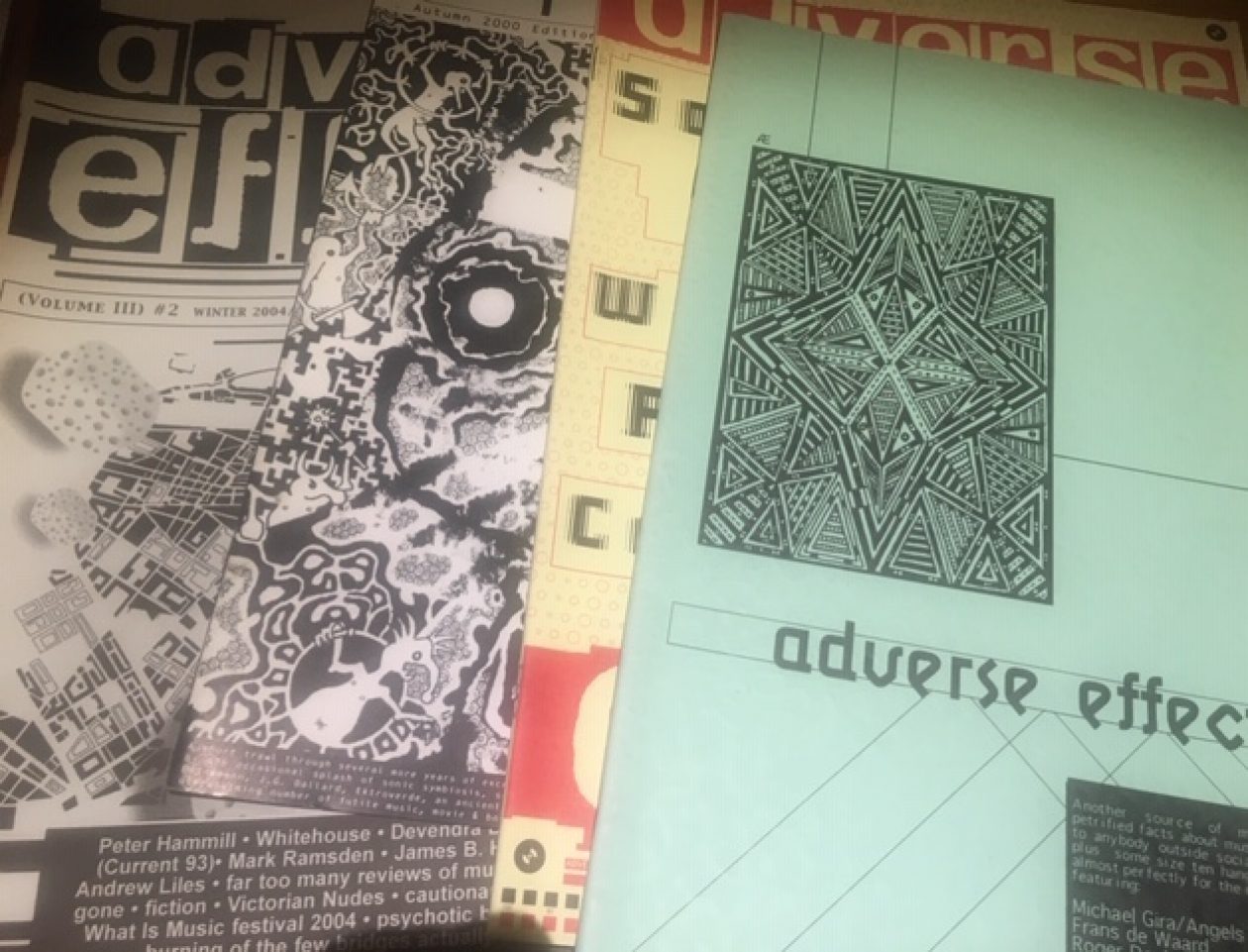
All reviews (so far) by Richard Johnson and Steve Pescott (SP). If you want Adverse Effect to review anything of yours please note we only accept physical formats sent to the address noted elsewhere. No time for unsolicited links and downloads, plus they get lost in the daily deluge of emails. Vinyl, CDs and cassettes at least get placed in the review stack and (eventually) get listened to. Tastes/interests are broad here as well.
Send to: Adverse Effect, Winnicka 57B, 32-020 Wieliczka, Poland
_____________________________________________________________________________
MUSIC
Cacophony ’33’ Ism of a Prism 8 x 3″ CDr box set (Park Holme Recordings, 2025)
The most recent collection of recordings by this solo project from Lincoln that’s been operating for several decades now and does not seem to care for aspirations beyond the positively DIY setting it has always been bound to. Like the others the man behind them, Kevin Kettle (a.k.a. Kevin ’33’) has sent my way before, the music is of a strictly electronic nature but has more in keeping with the minimalist approach once found on countless cassettes in the early ’80s. Utilising synths, loops and suchlike, these compositions are arranged around sparse and simple melodies, subtly sewn atmospherics sometimes straying towards the twilight zone, and occasional hypnotic rhythms of a robotic nature pinning things into place. On one hand recalling early Conrad Schnitzler at times, while on the other feeling like everything would sit comfortably alongside either Fad Gadget or Pseudo Code, it all ultimately points to music that could have travelled further if Kevin had ever wanted it to. These discs are each housed in a stickered plastic box that resembles an oversized glasses case, instantly layering on oodles of charm to an already endearing little set. Nice. (RJ)
Chameleons Arctic Moon CD (Metropolos, 2025)
The first album from the latest incarnation of Manchester’s finest unsung post-punk group for a number of years catches them in fine form, doing what they do best over seven new songs that at once pay homage to their earlier sound whilst delivering like something utterly contemporary and fresh. Back in the day, my ex-wife was a huge fan and was prone to playing the first couple of albums fairly regularly. Of course, not being content to hear what were essentially her records and having become completely smitten by them as well, I succumbed to buying my own copies, as well as third album Strange Times, from 1986. What always struck me about their music was just how atmospheric it was whilst still being able to either pack a punch when necessary or mould vast dramatic shapes rich in emotion. In a way, they recalled early Bunnymen with their thick, layered and moody mix of guitars, powerful undertow and Mark Burgess’ suitably impressive vocals veering between rage and regret. Arctic Moon retains everything that made the Chameleons glow vividly as an exciting proposition when their Script of the Bridge debut made its grand entrance in 1983, proving the group has lost nothing of its edge whilst maintaining a great level of songwriting that appeared mature right from the outset. Occasionally accompanied by synths, piano, orchestration and acoustic guitars that always partly defined them, it is an album that sees them veering between the more tender ‘Free Me’ to the more celebratory ‘Feels Like the End of the World’ and even bitterly poignant ‘Saviours Are a Dangerous Thing’, which doubles up as one of the highlights. While it can be considered a triumphant ‘comeback’ album, the group’s core has never really gone away. Always active in one form or another in those years when Chameleons were put on hold, it’s good they can still very much pull the same magic out of the bag that made them so compelling in the first instance. They may never have had the commercial success of some of their peers, but to those few who’ve long given them the attention they deserve Arctic Moon should prove as rewarding a listen as all else that rendered them so attractive in the first instance. Beautiful, majestic and arresting, Chameleons still sound relevant. (RJ)
Cowards Can You Hear Me? CD (Bloody Sound, Italy, 2026)
Second album from an Italian trio who kick up quite a storm with their combination of restless guitars, occasionally shouted vocals and chunky mid-paced rhythms. At times, I’m reminded of early Helmet, Tar and other such US groups that dominated the early ’90s and were championed by labels such as Amphetamine Reptile and Touch & Go. It was an interesting period that saw post-hardcore groups adopting a more intense and noisy approach which resonated with me far more than grunge. Like many of those groups, Cowards also nudge other ideas into their sound, however, such as the quiet restraint embedded into the dynamic and lengthy ‘9 Minutes’ or bassist Giulia’s voice appearing on tracks such as ‘Your Party is Gravy’, proving there’s more to them than their generating a punk-infused din. Worth pointing out that they sing in English as well. While I understand all the arguments for and against this, I personally believe it helps such groups if they have their sights set on higher goals than just playing the domestic circuit. Sounds like they’d be worth catching live, too. (RJ)
Delphium Dark Forces CDr (Aquese Recordings, 2026)
Seventeen more compositions from Jonathan Forde’s long-running solo electronics enterprise, continuing the roll he’s been on in recent years following something of a hiatus between 2003 and 2020. Most of these sidestep the more early techno-infused and ambient flavours of much of his output and, instead, dive deeper into his penchant for experimentation and conjuring moods the average person attempts to avoid. There’s a nice filmic quality to Dark Forces that’s sometimes still bound to rhythms and pulses, but at the same time a number of these pieces feel like sketches rather than fully realised pieces that perhaps beg for the attention of a collaborator to help give them some shape. Always interesting to see where Delphium goes next, though. (RJ)
DN.Aideath Snake Pit CD (Tesco Org., Germany, 2025)
Rather generic power electronics/abrasive noise-inspired fourth or fifth album from this Indonesian project of Tanaya Pratama’s. Nine tracks of unbridled barbed electronics, rhythmic swells, distorted shouting and griping and background howls. Even adorned in a cover referring to the Dutch military operations conducted in Indonesia in 1948. Oh well. (RJ)
Olgierd Dokalski Preludes to the Universe CD (Antenna Non Grata, Poland, 2026)
The latest album from this Polish trumpet player steadily sways between folk-ish accents that often border on the contemplative or mournful and a comparatively dramatic approach suggestive of Dokalski’s having many stories to tell. Using electronics and flugelhorn besides his faithful trumpet, the seven improvisational pieces here appear to illustrate a narrative arc reflecting the composer’s attempt to make some sense of formlessness. To that end, while he might well begin each piece with the vaguest idea or, indeed, the “chaos” of ideas suggested in the accompanying press notes, it rapidly becomes apparent that Dokalksi is highly accomplished and, drawing from his passion for traditional music, is able to craft wonderful refrains and a neat melodic undertow from his work that’s both rife with feeling and utterly hypnotic. I don’t know how the enchantingly titled Preludes… compares to his previous work, but this album is quite an accomplishment and, indeed, another triumph for this neat little Polish label already deserving of far more attention than it doubtlessly gets. (RJ)
Earth Mother Fucker Do Not Resuscitate CD (Antigen, 2026)
Since forming in the late ’80s, this group has only so far released something like six albums, which unwittingly provides a lesson many could learn from. Over the course of eleven songs, however, we are reminded of the fact that the energy and spirit of the Stooges is still a long way from diminishing. Along the way, there’s also a Cramps-like psycho-chug to be found on ‘Crooked Path’ and plenty of distorto-heavy guitars savaging the proceedings like the glory days of AmRep and Noiseville aren’t quite over. It’s like I stepped right back to 1989! (RJ)
Fiesta Alba ‘Drops of Sunshine in the City of Spectres’ CDEP (Neontoaster Multimedia Dept., Italy, 2026)
Interesting collection of five cuts that sometimes make me think of Spring Heel Jack being injected with a healthy dose of whatever DNA was responsible for The Residents. Lots of growling vocals, juddering rhythms bouncing in all directions, strings, squelching abstract electronics and the occasional song rising into view. Last track, ‘Kinder Egg Surprise’, includes some cut-up narration by contemporary Slovenian philosopher, Slavoj Žižek, a man whose oratory skills are forever rendered comedic for his unfortunately having a weird lisp that makes him sound like he has a mouthful of cold soup. Certainly an odd choice. (RJ)
John Gallen Improvisations 1 CD (Coastal Electronauts, 2025)
Each of these six tracks is akin to sliding into a glistening bath of electronics that chime, flutter and shimmer like one would expect well-crafted ambient music to. There’s lots of movement and carefully chiselled contours to keep the listener afloat, sometimes even forming babbling rhythmic patterns of a suitably hypnotic nature. From what I understand, Coastal Electronics operates from near my old ‘hood, in Whitstable, and is an imprint dedicated to a wide range of local electronic and experimental artists. Good to know we can now add something new to the seaside town’s otherwise being famous for once having the late Peter Cushing residing there (now survived by a ’spoons pub named after him) and being the oyster capital of the UK. (RJ)
Hvast Chwasty Polskie CD (Zoharum, Poland, 2025)
Five instrumentals form this debut by a Warsaw-based trio who merge electronics, guitars and even, on one piece, a flute with a sprightly yet hypnotic rhythm section clearly locked on the exact same mission. There’s a neat spacey undertow to the proceedings positively dripping in the steadily melting sprawl of kosmische-enriched mind extraction that faintly recalls Finland’s Circle or, at times, Pocupine Tree, but ultimately everything feels like Hvast are on to something of their own. The title translates to something like ‘Polish weeds’ and I have absolutely no idea what this is inferring. No idea what the group’s name means, either. Regardless, look forward to whatever they do next. (RJ)
Illusion of Safety Cancer LP (Auf Abwegen, Germany, 2025)
First released on CD by Germany’s Tesco Org. in 1992, this reissue collects the very same two compositions, one per side, by Dan Burke’s long-running project during a prime period where it also featured several other members, including Jim O’Rourke. Both pieces churn through a setting comprised of dusky oscillations, gutteral whirring, the ebbing and flowing of found sounds and lost chatter, submerged clatter, Philip Glass-like keys and what seems like monks chanting while a lonely bell rings a funereal toll. Heavily atmospheric yet rife with enough contours to buoy everything to a more intriguing level, Cancer takes the listener on a remarkable journey all the better for its occasionally appearing crude or undernourished. Certainly a worthwhile addition to those works where post-industrial music spread its wings to embrace a comparatively more academic approach, anyway. (RJ)
David J Tracks from the Attic Revisited CD (Independent Project Records, USA, 2026)
Following the first such collection of David J’s private recordings in 2023, the mighty Independent Project Records once again deliver another round of Bauhaus/Love & Rockets’ bassist showing off his pop chops. As one might expect from an artist who came of age somewhere between glam rock and punk, however, there’s a scoured ‘n’ scuffed art sensibility at work here. While most of the songs adhere to the position of singer-songwriter, most of them are possessed of carefully hewn arrangements and embellished with additional instruments from an array of collaborators on piano, percussion, accordion, additional guitars and so on. Even when the subtlest nods to country or folk music enter the fray, as they do on at least a couple of songs, one is still ultimately left feeling everything here would not exist without David J having once subsisted on a diet of Mott the Hoople, Bowie, Bolan and so on. That’s not to suggest his music directly sounds like any one of these artists, but the air generated by them hangs heavily over the proceedings. Everything points to his oozing a talent that could never have been fully contained by his work in the groups that put him in the public domain. (RJ)
Georgeanne Kalweit Tiny Space (NOS Records, 2026)
Fourth album from a US artist now based in Milan whose ten songs here sway steadily between the melodic sweep of Velvet Underground’s Loaded and, I dunno, The Flaming Lips or some such. Add a touch of Bontempi organ and a heavy sprinkling of bouncy rent-a-indie and Kalweit’s vocal delivery falling somewhere close to a particularly maudlin Patti Smith and you’ll have broken-hearted students drunkenly grooving before that inevitable collapse into a mattress of tears in no time. Some spaces are best left so tiny that the air will soon run out. (RJ)
Joke Lanz Chants and Growls by Mika the Dog CD (iDEAL Recordings, Sweden, 2025)
Joke has long been established as a figure operating in that grey and musty space where sound art, noise, electroacoustic composition and punk rock each collide into each other and simultaneously absorb healthy measures of surrealism, humour and general uneasiness. Besides a background that takes in all of this, Joke has also long been a member of the presently hibernating Dadaist project, Schimpfluch-Gruppe, from his native Switzerland. On Chants and Growls by Mika the Dog, however, we are treated to nine short sound manipulations that source various vocalisations from his late dog, Mika, presumably recorded at different points throughout her 13-year lifespan. As one might imagine, it’s not an easy listen and one that, instead, demands far more from those open to its world of ravaged whimpers, convoluted growls, decidedly oblique panting and other canine utterances. Above all, it’s a fittingly warm tribute to the memory of a companion by a sound artist such as Joke who, despite a heavily pronounced proclivity for the absurd and a tendency to look at life somewhat differently to most, comes across as reasonable and tender fellow possessed of a good heart. The CD itself is part of a series of limited editions on this label and only, I think, 80 copies exist. If you are a completist, good luck tracking this one down. Well worth it, though. (RJ)
Felicity Mangan String Figures LP (Elevator Bath, USA, 2025)
This excellent label once again proves itself as one of the best dedicated to that iridescent pool where ambient wafts of sound converge with more abstract inflections, occasionally deeper drones and electroacoustic composition. String Figures, by this Australian artist who relocated to Berlin in 2008, is both her latest release, following many low profile cassettes and suchlike over the years, and another strong addition to the Elevator Bath discography. Featuring six pieces neatly embedded on clear vinyl, it warmly embraces a combination of wheezing tones, vacillating hum, hazy rasps apparently tempered by the morning sun, perfectly glazed electronics and, somewhere along the way, the sound of frogs. It all adds up to an evocative setting that both invites repeated listens and reveals another layer of hidden beauty each time. I hope we’ll hear more of Mangan’s work on vinyl or CD in the near future. (RJ)
Mekons Horror + Horrorble 2CD (Fire, 2026)
Very interesting double set that pairs Mekons’ 2025 album Horror with a dubscape version of it mixed by Pere Ubu’s Tony Maimone. The original set of songs catches these punk first-wavers doing what they’ve been doing since the 1980s and perfecting an approach to songwriting informed by country, folk and the very same flames that got them going in the first place. Added to this is a heavy sprinkling of social commentary and general disgust with how things are in these war-torn times where the future can appear bleak for all kinds of reasons beyond. There’s always been a slightly scuffed indie aesthetic to Mekons’ songs that works in their favour but they also brighten matters up with an inventiveness which only propels them and underlines their commitment to their craft. On one hand, there’s a tinge of rosy nostalgia draped over the proceedings while, on the other, there’s something alarmingly contemporary teased into the mix that keeps everything fresh. On the other disc, old friend of the group Maimone pulls the songs on the album inside-out to mould a dub-infused collection that thankfully sidesteps anything gimmicky in favour of drawing rich textures from the space also necessary to retain the essence of the songs themselves. It’s a concept that could so easily have collapsed into something sonically hideous but works well due to Maimone’s long-ingrained understanding of balancing sound with an artistic sensibility that can have a greater reach. Each song unfolds with new life as it is stripped down and rebuilt with the help of atmospherics and attention to the expanse crucial to dub’s lifeforce. It’s a rewarding counterpart to the main album that’s both more reflective for the most part and sonically richer, ultimately proving the entire album as anything but ‘horrorble’. (RJ)
Mesmer Terrain Vague II (Arbitrary, Denmark, 2026)
Following 2023’s Terrain Vague album comes this second album by Danish improvisational soundwork trio Mesmer, who here sculpt six compositions from field recordings and the use of trumpet, percussion and electronics intended to blur the lines where culture and nature merge. To that end, there’s a rich, organic feel to these pieces which serves them well, especially given their often leaning towards a setting where structure and mood take precedent. Sometimes sombre and mournful, at other times more playful or attempting to reach those decidedly more celestial planes, Terrain Vague II is at the very least an engaging journey from start to finish. (RJ)
Monocube & Troum Contemplator Caeli CD (Zoharum, Poland, 2026)
Reissue of this 2019 collaborative album, originally released by Troum’s own Transgredient imprint as a very limited LP. Remastered and including an additional fifth track from the same sessions, these compositions meld deep atmospherics with an attention to detail in a soundbed of tones and shimmers that sound positively crystalline on this format. Troum are old hands at this game and true masters because of it, while Monocube have been operating in similar realms for a couple of decades. My only criticism, therefore, would be in such a collaboration being founded by similarly-inclined artists. All the same, everything works beautifully here, including the sedate nods to some of Coil’s later work. Nice. (RJ)
Are Mundal A Prior Beef Between Two Mummified Insects LP (Telesterion, Norway, 2026)
On what is now the sixth album by this Norwegian artist we find two side-long pieces that witness him shifting slightly from the penumbral murmurings of previous releases to a more molten soundbed that has greater emphasis on disparate sources pulling together. Electronic rhythmic passages inspired by Conrad Schitzler’s work serve as beacons from which nicely crafted ripples of sound emanate, submerged voices make their presence felt and indiscernible tones, babble, thumps and random clicks and clangs help to create a moody setting closer to Nurse With Wound’s more tempered works than any dark ambient fare. Everything points to a maturity to Are’s craft I hope will continue to grow. Highly addictive material. Only 100, too, so get to it. (RJ)
Open To The Sea Watering Paper Flowers and Snakes 2CD (Alma De Nieto, Italy, 2025)
A collection of seventeen tracks by this Italian trio who fuse a contemporary sheen to a very well polished jostling of ideas that have arrived from lounge, electronica, progressive rock and post-rock sensibilities. There’s certainly an inventiveness that’s hard to fault, but everything’s ultimately a little too saccharine for my tastes, coming over more like a pregnant display of virtuosity than much else. Interesting title, anyway. (RJ)
Rapoon & Pas Musique Knowledge Has No Enemies But the Ignorant 2CD (Zoharum, Poland, 2025)
While I remain generally sceptical of double albums by groups furrowing those more, um, experimental realms of music, the rather delightfully titled collab here at least has the common courtesy to keep both discs to a respectable length. Comprising thirteen cuts in total, these works catch longstanding hypno-ambient boffin Robin Storey actually detouring with partner-in-sonics Robert L. Pepper of NYC’s Pas Musique to a time when his former group :zoviet*france: chiselled glorious compositions from clunking electronics, coarse textures and so on to considerable effect. Each of these pieces manages to successfully merge a neat array of ideas and sounds to something resembling a coherent whole that at once sidesteps predictability and is immersive. I don’t know how this compares to other Pas Musique work, but it’s a refreshing angle on what Rapoon is largely known for (and I’m not complaining – I like Rapoon!) and proves there’s still plenty of scope in it to explore. Wonderful stuff. (RJ)
RG Rough 80 LP (Bam Balam, France, 2025)
Following the previous two albums of his built around the same concept, namely 60 and 70, arrives this recent entry that’s this time only sourcing sounds and snippets from releases from the ‘80s as a starting point to these ten compositions (one for each year, natch!) then melded into two side-long pieces. Over their course, we are helplessly tugged along a rhythmic setting drenched in corrugated psychedelia and electronic swirl that at once recalls the spirit of kosmische music whilst feeling utterly contemporary and not unlike the muffled thuds of a club’s back room blasting out brain-rearranging tech-house at 3am. More simply, this is another remarkable album from Robert G Rough, who appears to have been honing his craft for well over a decade now and has collaborations with both Makoto Kawabata and Richard Pinhas behind him I still very much need to get. The cover artwork also features the sleeves of the many albums 80 is sourced from, plus there’s also a postcard inside featuring Robert surrounded by a number of them (I recognised Coil and JAMC amongst them). Am only surprised more are not picking up on this work. (RJ)
RLW Fading Pictures CD (Black Rose Recordings, 2025)
Ralf Wehowsky’s longstanding alias, RLW, has always been devoted to his own stamp on musique concrete and electroacoustic composition and never once compromised the notion of exploring sonic forms that pay scant regard to easy digestibility. While this all makes sense given his background as a member of Frankfurt’s premier post-industrial outfit P16.D4 during the ’80s, one has to admire the stoicism at work when considering the sheer adversity or indifference such music tends to face. Fading Pictures, however, is somewhat surprising for its being less impenetrable than usual. By that, I don’t mean to infer that it wouldn’t still clear a room full of K-pop fans but, rather, that many of the sounds teased into the shapes forming the nine compositions here often feel refined to the point they wouldn’t be out of place on a more interesting ambient album. Ultimately, though, Fading Pictures slots alongside Wehowsky’s general remit pretty well in that it’s head music requiring full engagement in order to get to the chewy nuances, subtleties and tiny fragments that appear to assume new lives as they career in multiple directions. If one listens hard enough, there’s even a vague musicality to be found breaking away from the miasma of glazed tones, contorted banks of digital drizzle and serrated slivers of noise at certain junctures. The last few tracks, between them, twist steadily from a dramatic slur of almost modern classical proportions to a setting of near-ambient ringing and chiming before being escorted to foggy waters punctuated by moody horn swells. An utterly compelling album from start to finish, plus there are some nice liner notes from the man himself concerning his techniques and approach to his electroacoustic works, as well as the concept behind this album. (RJ)
Satori Power of the Gun CD (Industrial Recollections, Finland, 2026)
Beamed in from a satellite orbiting Finland’s Freak Animal imprint, its main focus of attention being the reissue of deleted/rare releases of an industrial/electronic/harsh noise stripe. In the past few years, releases by Japanese heavy hitters Government Alpha, Monde Bruits and the USA’s Macronympha have been reactivated and now it’s time for something slightly less commonplace as Satori, from the legendary and fiercely uncompromising Broken Flag label, emerges from the undergrowth. As this repro is a bit of an event in my little world, I’m a mite surprised and slightly disappointed by the lack of accompanying sleeve info. After all, a group history wouldn’t have gone amiss, but all we have is the bare bones; stencilled cover art, group name and track listings. Never mind, I’ll just have to tap in to the absolute pinnacle in industrial/avant-garde sourcemags instead; Steve Underwood’s stand-alone As Loud As Possible from 2010…
The genesis of this still ongoing project (albeit with different personnel), takes us back to 1988, which saw the Kentish duo of Robert Maycock and David Kirby at the helm. Like their eponymous debut (BF 64), Satori’s essence was again presumably influenced by their use of an acoustically inviting, disused air-raid shelter (locally sourced), where rusting, corrugated tin, crumbling brickwork and encroaching vegetation could only reinforce a claustrophobic and apprehensive outlook upon the listener. A bit of ‘artistic tension’ as one-time Berlin resident David Bowie once noted.
The harsh choices emerging from the titles department (the cruel/tease of ‘Flayed 1’, ‘Flayed 2’ and ‘Pain Clinique’) complement in sonic terms, the kitchen sink/found sound wreckage that punctuates (think of a circus knife act) the steady surge of analogue circuitry writ large on the title track and even more so on ‘Heel’ where the religious fervour of a TV evangelist launches into full-blown hysteria. Hopefully this particular trickle will elicit a steadier flow of BF reissues from Industrial Recollections, or by others spurred on by this rare lightbulb moment. We can dream. (SP)
Shape Navigator Journal CD (Coastal Electronauts, 2026)
Channelling the spirit of Cluster and early Tangerine Dream arrives Shape Navigator, a project which commenced in the early ’90s before laying dormant in 1996 following a series of 12”s aimed at the clubbing circuit. Peter Coyte, the man behind SN, has clearly hung up his dancing shoes in favour of something appropriately more measured and cerebral for those edging further into their autumn years artistically. Each of these nine tracks might sit comfortably alongside classic works by certain pioneers of electronic music from the early-to-mid-’70s, but there’s a healthy contemporary sheen to them as well that doesn’t detract from the overall feel. Veering between dystopian sci-fi atmospherics and the domain of the wild-eyed scientist honing his craft in a basement teeming with cables and malfunctioning analogue equipment, Journal, replete with a couple of nods to Coyte’s surroundings in Kent tucked into the titles, suggests plenty more entries to come. (RJ)
Colin Andrew Sheffield Serenade LP (Elevator Bath, USA, 2025)
It’s been a good couple of years since Colin Andrew Sheffield’s previous two albums, Images and Don’t Ever Let Me Know, graced our ears courtesy of both his own Elevator Bath imprint and Germany’s Auf Abwegen, so
Serenade is a welcome addition to his steadily expanding catalogue. Already respected as one of the better artists dedicated to ambient sculptures and slowly shifting atmospherics in more recent years, it’s no surprise that this new album delivers another nine compositions of magical driftworks often impregnated with sounds that either wouldn’t appear out of place on something of a more industrial-noise leaning or that resemble heavily timestretched bells reconfigured to the point the clangs have been eradicated. On final cut, ‘Testament’, an altogether more sombre mood cuts through with a dramatic refrain that does much justice to the overall tone, overtly rounding off an album that’s compelling the instant the needle drops. Extremely limited, too. Highly recommended to those who like their ambient music somewhat more demanding. (RJ)
Tape4 eponymous LP (no label, Poland)
One might be forgiven for thinking that the idea of getting four sound recordists together who each usually splice field recordings, ambient-noise and snippets snatched from abandoned tapes might not seem that enticing initially. However, the four works here, assembled by Maciek Olewniczak, Marcin Barski, Marcin Dymite and Patryk Daszkiewicz in different configurations, counter such misgivings immediately as they churn through neatly collaged and sometimes looped meshes of dialogue, penumbral hiss, found sounds and suchlike to create a whole that wavers steadfastly between the atmospheric, hypnotic and mischievous. Let’s hope Tape4 can pull a few more tricks out of their collective sleeve for another release. (RJ)
Asmus Tietchens Conclusio (Die Stadt, Germany, 2025
If there’s just one musician out there who straddles those gaps between the days of classic krautrock (Can, Faust, Neu, etc), to ‘Neue Deutsche Welle’ (Der Plan, Xao Seffcheque…) to the more contemporary sounds of Kreidler and, say, To Rococo Rot… then it surely has to be Asmus Tietchens. From time served on the Lilienthal album sessions in 1978 (with Dieter Moebius and Conny Plank), then taking in a veritable who’s who of underground labels including Korm Plastics with a brief stay at Nurse with Wound’s United Dairies on the way. With over a hundred releases under his belt (!!), he now finds himself at the house of Die Stadt (but for how long?).
Conclusio‘s sleeve-art might provide a clue to its contents in terms of feel. One can see a massive discoloured room space, its heavily concreted frontage revealing a somewhat imposing, unlit door. What lies within? Our entry point comes with the piercing metallics and cavernous reverb of ‘German Angst’. Mirroring that approach with ‘Imperial Logistics’, ‘Perle’ and the nightmarish ‘Lammkopf im Ofen’, a rich seam of contempo industrial tropes have been mined that can purposefully move towards down tuned soundtracking aesthetics. Fans of Throbbing Gristle’s Shadows of the Sun and Heathen Earth albums, where Gen and co. went more in a widescreen direction should investigate Conclusio pretty sharpish.
Aficionados of k-rock’s first wave might be interested to know that Asmus Tietchens’ long-term switch-doctor: Okko (Bekker), had a brief recording career of note back in 1971. Merging eastern sounds with western circuitry, Sitar & Electronics (BASF Records), does have its fair quotient of good moments but occasionally strays into library music territory with two inevitable Beatles covers. (SP)
Mikołaj Konstanty Trzaska & Daktyle Transient Riot CD (Antenna Non Grata, Poland, 2025)
Once again the ANG label excels in bringing out releases by mostly Polish artists who I’m largely unfamiliar with yet produce fantastic work in the realms of sound art, improvisation, free jazz and abstract electronic music. Transient Riot is no exception as it brings Gdansk’s clarinetest/sax player Mikołaj Konstanty Trzaska together with electronic music duo Daktyle for nine tracks of heavily persuasive ear-burrowing that draws from free music as much as avant-garde composition and a contemporary form of psychedelia stripped of all its fat before being pulled inside-out. Saxophones career around and caress a neat array of crackling, babbling and fizzing electronics themselves sometimes unfolding in a spacey direction while stark, minimal yet unobtrusive percussion does its utmost to pin everything down. Recorded live at a show in 2024, the album benefits not only for its rich and raw alchemical meeting of minds, but also for the music’s ability to reveal more with every listen. Powerful and occasionally playful, it’s an emotive ride I’m sure would have been fantastic snagged in its original setting. Good shit. (RJ)
Uton Unusual Suggestions LP (L’eau Des Fleurs, France, 2025)
Since this Finnish guy started his sonic journey at the beginning of the century they’ve produced countless releases, some physical but mostly digital, and don’t appear to be letting up any time soon. This is just as well as they plough a space somewhere between abstract electronic music of a ragged ’n’ jagged nature and a molten pot of heady swirl just about formed from, presumably, whatever instruments and sound-making devices they can lay their hands on. The two side-long pieces pull you in, throw you about over the course of their respective durations and leave you bewildered yet hankering for more. Somewhere, in a distant corner of the known universe, this might well be considered pop music. In the context of our reality, however, it just sounds like all the clanking, clicking and squiggling components were put together wrong yet is all the better for it. Only 150 of these were pressed. Yet another future oddity in the making. (RJ)
Woo Whichever way You Are Going, You Are Going Wrong CD (Independent Project Records – Sunshine Series, USA, 2026)
Kerr-IST! This reissue takes me back to a time when I was but a callow youth, regularly gambling on hyperbole-rich music press reviews and/or rash impulse buys. My purchase of Whichever… being reliant, if memory serves, on numerous accolades from Melody Maker and the N.M.E. It must’ve hit home after a couple of plays, as the album has been lodged in my collection ever since 1982. Comprised of brothers Mark and Clive Ives (who are still wooing it to this very day), this London duo were and indeed still are a difficult beast to successfully pigeonhole. Strands of suburban psych, pastoral electronica, world music and exotic prog folk seamlessly blend together, sometimes even within the confines of one song. Following on from the Robot X/Xylophonics double set, which was Independent Project’s first deep dive into the Woo archives, the newly remastered strains of Whichever… still hit the target. Examples being ‘The Attic’ (adapted from a Roger McGough poem) which is the equal to Felt in their heyday and, say, ‘The English Style of Rowing’; its languid dreamy atmosphere finding echoes in Goodbye & Hello-era Tim Buckley.
All things considered, the album’s understated charm is still evident from the opening ‘Swingtime’ to the closing title track, so stylus/laser hopping is simply out of the question. The lure, however, for fanboys of obscure UK cottage industrialists such as Eyeless in Gaza, Leven Signs, In Embrace and Bron Area is that Independent Project have gone the extra mile or so by adding a generous ten bonus tracks. These are all unreleased and refer to recording sessions made some time before their debut album. With ‘Ruby Ruby”s gorgeous vari-speed guitar chime, the sedate chug of ‘Tibetan Trains’ and ‘Baa Lamb’; a soft-shoe shuffle with pixiephone and clarinet filigree, there’s no way that these add-ons could be conceived as mere sweepings from the cutting room floor and instead, could easily function as a stand-alone release. Be prepared for abrupt endings though…
Better men than I have said this… but what the hell. This is yet another sumptuous slice of not only ear-candy but eye-candy as well. The visuals/packaging crafted by label majordomo Bruce Licher are a true labour of love and I would rank his artistic vision several levels above 4AD’s Vaughan Oliver and Factory’s Peter Saville. Hmmm… this must be what a rave review looks like! (SP)
Various Louder Than You Think: A Lo-Fi History of Gary Young and Pavement CD (Independent Project Records, USA, 2026)
The late Gary Young is best known for his role as the original drummer of Pavement between 1989 and 1993. Prior to this, he cut his teeth in hardcore punk groups The Authorities, Fall of Christianity and Hot Spit Dancers, plus was known for organising shows by Black Flag, Dead Kennedys and others in Stockton, California. However, he was also known for his unpredictable behaviour and its not being helped in the least by a prediliction for drugs and alcohol that ended up with his dying in 2023 from complications that arose from this. Louder Than You Think is a documentary released the same year given to his life and this album is basically the soundtrack, taking in his early hardcore punk dabblings, a detour of babbling electronics and more abstract sounds courtesy of Edward W. Dahl. a few live Pavement recordings and experimental ambient-pop compositions by producer Noah Georgeson (one of which sees Gary Young himself collaborating). Also to be found are three art-pop songs by Gary Young’s Hospital, who themselves released two albums and included one or two others from his hardcore punk days. Even though Pavement was his biggest success, it’s clear the group was also possessed of this slightly scuffed and dishevelled punk spirit that had been there from the start yet went on to embrace lo-fi noisy pop, or even an overtly more melodic direction that saw them garner considerable attention before their demise in 1999. Having seen the documentary, this typically lavishly packaged IPR release, replete with a booklet featuring liner notes and photos, serves as both a solid enough accompaniment to it as well as being a fitting testament to a man whose role in US indie music can only be viewed as important. (RJ)
V/A The Well (The Independent Project Records Collection II) 2CD (IPR, USA, 2026)
Despite having released several compilations myself over the years, I’ve never been massively into them. I understand and appreciate their general purpose, of course, but they often include too many tracks I wouldn’t ordnarily go near even if my life depended on it. The huge and, some might argue, ambitious collection that forms this insight into US label Independent Project Records, is no exception, really. As much as I love many things about this label, from the fact it spawned label owner Bruce Licher’s own mighty post-punk outfits Savage Republic and Scenic to the iconic and highly influential screen-printed presentation of its releases, it has been responsible for putting out a lot of more regular indie and shoegaze music besides what I’d consider the more interesting stuff. Much of the latter is represented here by contributions from the likes of Woo, Alison Clancy, Springhouse, Half String, Middle Class and others, but there’s a powerful dollop of classic post-punk courtesy of Licher’s projects, plus Kommunity FK, Fourwaycross and more to help counter this. In between everything, there’s also the psychedelic rock of Shiva Burlesque, the avant-pop of Camper Van Beethoven, the art excursions of Bauhaus’ David J, Lanterna’s ambient electronics, Edward W. Dahl’s film soundtrack work and far more. Like all the best labels, it wouldn’t be unfair to say there’s something of a common spirit binding each and every one of these artists, anyway. Moreover, it’d be dull if a label only focussed on one area of music and nothing beyond. This overview of IPR is extensive, typically well put together, features liner notes and ultimately serves as an introduction to the wide range of artists it has helped promote over the years. There’s plenty here to satisfy anybody’s own tastes, too. To that end, and in spite of my own misgivings about compilations and, especially, those that include a few too many indie groups for my liking, mission accomplished. (RJ)
BOOK(S)

Anarcho-Punk Was Always Destined to (Generally) Fail: A Review of Beyond the Monochrome, a book by Chris Low
My introduction to anarcho-punk arrived courtesy of two Crass singles being kindly given to me by somebody at school in the year below me when I was around 14 or 15-years-old due to my being the only person he knew who still liked punk. These 7”s were ‘Reality Asylum’ and the split single with Poison Girls, ‘Bloody Revolutions’/‘Persons Unknown’. Excited, I took them home and could not stop playing both over and over again on my cheap hi-fi whilst completely transfixed by the artwork, the slogans and what ultimately proved to be my introduction to the world of anarcho-punk (even if I was oblivious to this at the time). While I was not quite ready for the sprawling tape collage-backed spoken word of ‘Reality Asylum’, I vividly recall playing its more immediate flipside track, ‘Shaved Women’, countless times before moving on to ‘Bloody Revolutions’ and its acerbic critique of violence used as a tool for revolution or protest.
Not long after obtaining these two singles, I started to explore Crass’ world a little more and began to expand my collection of singles with releases by Zounds, Flux of Pink Indians, The Snipers, Annie Anxiety, The Mob and Rudimentary Peni over the course of the next couple of years. Like many of the other punk/post-punk records I already owned, I got more from these singles than just the music. Drawn to their fold-out sleeves, the thought-provoking montages and stencilled typography, the experimentation underpinning the often otherwise ferocious music and the mostly black-clad image of the groups, there was this overriding feeling that they each represented something completely against the grey and oppressive future it seemed like we were all facing. Of course, the text and sloganeering against war, the government and the rich, as well as that concerning animal rights, individualism, autonomy and existentialism, amongst others, was also perfect for my tender age to begin prodding at topics I’d barely considered before. As I waded through this heady mix I couldn’t deny its appeal even if I didn’t wholly subscribe to everything proffered. Rather, it was mostly the music that grabbed me, followed by the packaging and the stew of ideas bubbling within.
One of my main misgivings about everything presented was the idea that all the hyperbole over ‘anarchy’ ultimately pointed to a conviction that humanity could somehow overcome all of its failings and live in a utopian state. Between reading Lord of the Flies at school and my own early childhood being discoloured by (sometimes physically) fighting parents as they crashed towards divorce, plus just witnessing how those around me behaved towards each other, the little faith I might have had in our species began to dissipate as I crawled through my teens. The idea that ‘freedom’ implied having no government, military or police, etc. just seemed faintly ludicrous. Such lofty idealism was not only the domain of fantasy, but also reminded me of the naive and patchouli-scented hopes and dreams of the hippies.
All the same, there was more to anarcho-punk than myopic utopianism, which brings us neatly on to Chris Low’s Beyond the Monochrome book, itself collecting photographs and graphics from this vibrant area of the 1980s underground all taken or gathered by Chris himself. Having once been the drummer in wild anarcho-experimentalists The Apostles, as well as later performing the same duties in both Political Asylum and Oi Polloi, who themselves had strong ties to anarcho-punk, places Chris as something of an authority on the subject. However, more than this, he was actively involved with the early ‘80s squatting scene in London, produced ‘zines, participated in Class War protests and others, maintained a viable presence through his writing and photography, and ultimately must be amongst a tiny minority who documented so much of it so well.
The foreword and introduction to the book by Napalm Death founding member Nick Bullen and Chris himself highlight the appeal of anarcho-punk while simultaneously illustrating exactly why it happened when it did. The UK of the late ’70s and early ’80s looked bleak due to the threat of nuclear war, mass unemployment, strikes, the closing down of industry, political unrest, race riots and a future being shaped by globalisation and a pop culture that began embracing an escapism far beyond the reach of the average person. Given this context, it is easy to see how a thriving segment of the underground, driven by punk’s anger, frustration and energy, reacted so vehemently. It was a time of unrest and uncertainty, so the melding of anger to an array of causes and beliefs one could get behind if desired inadvertently offered a sense of unity and hope. At the very least, the thought that change was possible didn’t appear so unrealistic for many in this somewhat desolate environment.
The 68 photos reproduced here, ranging from groups such as Conflict, Crass, Omega Tribe, DIRT, The Alternative to those Chris was also involved with, as well as snaps of the Punx Picnic in Edinburgh, protesters and the obligatory shots of punks making a stand against cops, certainly provide vivid insight into a period that went on to influence many in the form of poltical awareness, activism, a DIY approach to organising concerts, publishing and all creative pursuits, or even lifestyle choices. Along with each of these photos there’s text and plenty of (sometimes humourous) anecdotes by Chris and others, such as members of Oi Polloi, Riot/Clone and Omega Tribe, which not only provide a backstory to them where possible, but also form a narrative further compounding what anarcho-punk meant to those involved. For some, it galvanised a lifelong commitment to a facet of it that continues to this very day, such as embarking on a vegan or vegetarian diet, while others fell by the wayside due to addiction problems or simply not taking care of themselves (the recounting of squatters succumbing to Trench Foot and scurvy, besides other diseases no doubt, only compounding my belief such people hardly represented a fantastic alternative future when they couldn’t even take care of personal hygiene).
Due to my own background, a lot of this material was already familiar to me, of course, but what shines alongside Chris’ own knowledge and passion for an area of underground culture that clearly informed him is the idea that such a document was needed. And as much as the photos, in all their grainy glory, capture the spirit of it all, there’s probably room for a far more expansive book on the subject.
While I still wholeheartedly stand by my old position on most of this amounting to little more than the domain of blindsided idealism, I would also surmise there was something of value at the heart of anarcho-punk. Chris himself acknowledges the former with the occasional wry comment on how things seemed when he was so much younger. However, he and his colleagues succeed in painting a picture that’s easy to understand as having been exciting, attractive and an aid to one navigating their way through their youth and into adulthood. Anarcho-punk, replete with the iconography, sloganeering, cool jet black image and, indeed, sometimes incredible music that still holds up today, formed an important part of the landscape to those of us seeking music and ideas outside the mainstream at the time.
To that end, this book comes recommended to all who grew up with this or who, like myself, either dabbled with it or remain interested in everything that happened culturally from the late ‘70s to early/mid-’80s. It’s an excellent document that I’d like to think Chris made a neat little profit from for all his hard work. Even anarcho-punks need money.
NB: The first edition of this book has sold out but a second is underway and should be available to pre-order soon.
(Richard Johnson)

